LIGHTING THE
LONG VIEW
LONG VIEW Nick Hoggett, partner at dpa lighting consultants, reflects on the Middle East’s transformation from early landmark projects in Dubai to today’s culturally grounded, masterplanned developments.
Interview by Ray Molony.
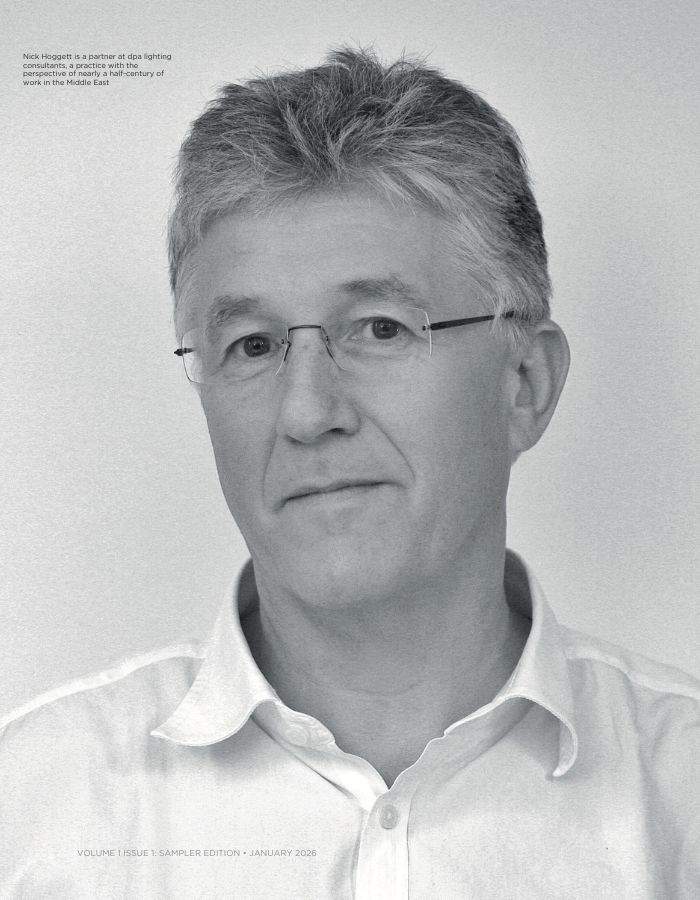
When Nick Hoggett, partner at dpa lighting consultants, talks about the Middle East, he does so with the perspective of a company which has watched the region evolve for nearly half a century.
The practice’s first project in the Middle East – the Sheraton on the Creek in Dubai – was back in 1977, a joint venture between dpa founder Derek Phillips and US lighting legend Howard Branston.
That project, Hoggett explains, marked the beginning of a relationship that now spans close to 50 years. ‘When people talk about Dubai nowadays, we can say we’ve been working here since ’76 or ’77. It’s rather a nice start.’
Hoggett joined the practice himself in 1979 and remembers the Sheraton not as a modest footnote, but as a landmark for its time. ‘Deira was the centre of everything. The Sheraton on the Creek was a signature piece of architecture,’ he recalls. Inside, the atrium was pyramidal, finished in bright yellows, oranges and mauves, lit with PAR38s and PAR56s at mains voltage — equipment typical of North American specifications at the time. ‘It’s a wonderful bit of history for us.’
For Hoggett, one of the biggest misconceptions is treating the Middle East as a single design culture. ‘It’s impossible to describe the culture of design in one single statement,’ he says. ‘The Middle East is completely varied.’
A decade ago, international attention focused almost exclusively on Dubai. But Hoggett stresses the differences. ‘Abu Dhabi was much more conservative in approach, while Dubai was more flamboyant. Saudi Arabia was doing interesting things in the background, Oman was producing restrained, elegant architecture, and beyond that you have Lebanon and Egypt — the Middle East is far broader than people assume.’
Over time, he has seen a clear shift in priorities. ‘There was an incredible aspiration to produce the tallest, brightest, shiniest, biggest everything,’ he says. ‘That aspiration has developed. Now there’s much more emphasis on quality of thought, sustainability and purpose.’
While he is cautious about overstating progress — ‘I’m not totally convinced sustainability is always achieved’ — Hoggett is clear that the intent is real. ‘We’ve gone away from ‘it must be the biggest and brightest in the world’ to something that has a quality and belongs to a bigger picture.’
A Region, Not a Monolith
Masterplanning and Early Engagement
One of the most significant changes, in Hoggett’s view, has been the way lighting design is integrated into large-scale planning. ‘There’s been far more thought on masterplanning than we’ve ever done in the UK and Europe,’ he says, citing projects such as DIFC and Palm Jumeirah as early examples where lighting was considered at a strategic level.
That approach has accelerated in Saudi Arabia. ‘We’re now seeing lighting designers engaged at the earliest stages of masterplan work, even pre-concept,’ Hoggett says. ‘Setting lighting principles, aspirations and hierarchies — that really is the holy grail.’
The scale of ambition is matched by architectural quality. ‘Saudi Arabia is employing some of the greatest architects around the globe,’ he notes. ‘Lighting design is recognised as a significant contributor to the success of a building — whether that’s making it iconic at night or shaping the experience inside.’
‘In the 1980s we had to convince clients that they needed a lighting designer. They’d say: ‘We’ve got an architect, an interior designer – why do we need you?’
Recognition of the Profession
For Hoggett, this recognition marks a profound shift from earlier decades. ‘In the 1980s we had to convince clients why they needed a lighting designer,’ he says. ‘They’d say, ‘We’ve got an architect, we’ve got an interior designer — why do we need you?’’
Today, that conversation has largely disappeared. ‘Now it’s completely accepted that a project will have a lighting consultant. You’re not fighting for the existence of the role anymore — you’re fighting to show why you’re the right one.’
He sees this acceptance across the region, from the restrained resorts of Oman to high-profile developments in AlUla. ‘People don’t expect Saudi Arabia to be producing candle-lit, eco-friendly camps with minimal artificial light — but it is. And that’s fantastic.’
Public realm projects are another indicator of maturity. Hoggett points to Riyadh’s Sports Boulevard and the redevelopment of Diriyah, rooted in Najdi architecture. ‘It’s not just shiny buildings anymore. There’s real investment in public space and cultural identity.’

A Standout Project
Asked to single out a project from dpa’s extensive Middle East portfolio, Hoggett hesitates. ‘We probably have around 100 projects running in the region, and they’re all different.’
Still, one stands apart. ‘If I had to choose, it would be the Founder’s Memorial in Abu Dhabi,’ he says. ‘It’s not the biggest project in the world, but it’s an incredible piece of work — working with an artist to create a memorial to Sheikh Zayed. It’s very special for us as a practice.’
Specification, Substitution and Quality
Hoggett is candid about the challenges of maintaining quality from specification to installation — and clear that the issue is global. ‘This happens everywhere: London, Europe, the Far East. It’s not a Middle East problem.’
His approach is deliberately pragmatic. ‘We believe we’ve specified the best product because that’s our job, but we should be humble enough to recognise there may be alternatives that are nearly as good and cost less.’
The key, he argues, is collaboration rather than dogma. ‘If a contractor proposes an alternative, we say, fine — but we need to see a working sample. We don’t trust data sheets alone.’
Side-by-side testing, involving clients and project managers, usually makes the decision clear. ‘Eighty percent of the time, you turn the lights on and it’s obvious the alternative is unacceptable. In the other 20 percent, you test properly — colour, optics, CRI — and make an informed call.’
‘The aspiration has developed. Now there’s much more emphasis on quality of thought, sustainability and purpose.’
Talent and the Talent Gap
Like many practices, dpa faces recruitment challenges. ‘Finding high-quality, experienced people is difficult everywhere,’ Hoggett says. ‘The profession has expanded faster than the pool of experienced designers.’
The Middle East presents a particular issue. ‘Saudi client bodies are employing lighting designers directly and paying extremely attractive salaries,’ he explains. ‘They’re paying more than consultants can afford, because our fees don’t allow us to double salary scales.’
At graduate level, however, the pipeline is strong. ‘There’s an amazing stream of graduates coming out of places like the Bartlett [School of Architecture at the University of London], [the Hochschule] Wismar and [the KTH Royal Institute of Technology in] Sweden,’ he says.
Visa and salary thresholds make the UK harder, while Dubai remains more flexible. ‘If young designers want to work in the Middle East, it’s much easier to engage them there.’
Fees, Pressure and Value
After more than four decades in practice, Hoggett remains realistic about fees. ‘They’ve been under pressure since I started in 1979, and they still are.’
Recognition of lighting’s importance has helped increase fee levels, but not necessarily profits. ‘Oftenit just means we put more time and effort into each project,’ he says. Ultimately, he sees fees as a simple function of supply and demand. ‘If work dries up, fees will go down. That’s the reality.’
What matters most, he concludes, is understanding value. ‘If clients want professional lighting designers to do great work, they need to pay enough for us to put the time in. It really is as straightforward as that.’
The Constellation at the Founder’s Memorial, Abu Dhabi
An iconic lighting design project for dpa lighting consultants is The Constellation,, a permanent public artwork that forms the centerpiece of the Founder’s Memorial in Abu Dhabi, dedicated to the late Sheikh Zayed bin Sultan Al Nahyan.
The artwork was conceived and designed by an artist whose practice focuses on human perception through large-scale public sculpture and installation. The Constellation is set within the landscaped grounds of the Founder’s Memorial, which include indigenous planting from the Arabian Peninsula, an elevated walkway with views across the city, and a welcome centre incorporating a multimedia exhibition.
The sculpture is housed within a prismatic pavilion at the centre of the site. It comprises more than 1,300 geometric forms suspended from over 1,000 tensioned cables. The forms are variations in scale of the five regular convex polyhedra known as Platonic solids, selected for their mathematical structure and symmetry.
To achieve a three-dimensional nighttime presentation, a bespoke lighting system was developed, consisting of 753 downlights and 1,203 uplights illuminating the sculpture from above and below. Each fixture incorporates a 3.5W warm white LED with integrated DMX control, allowing precise adjustment of light levels to respond to the differing textures and geometries of the individual elements and the composition as a whole.
The Park Hyatt Kuala Lumpur, Malaysia
dpa lighting consultants have completed the newly opened luxury hotel and the first Park Hyatt in Malaysia, housed within Asia Pacific’s tallest tower, Merdeka 118.
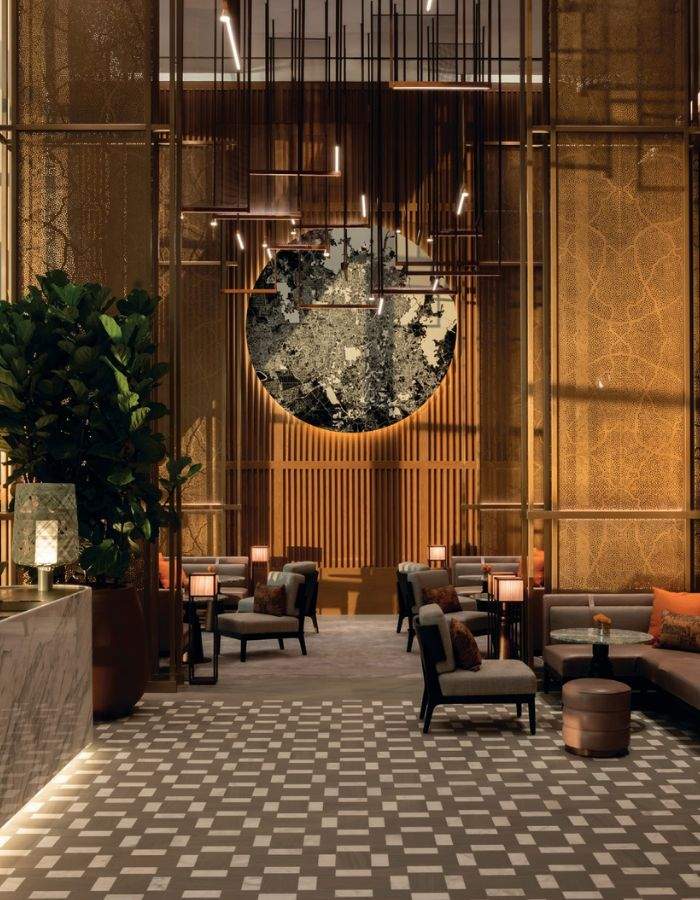
Appointed as the lighting designers for the landmark hotel, dpa collaborated closely with world-renowned interior designers GA Group. The hotel’s interiors draw inspiration from a traditional Malay Kampung house, blending local craftsmanship and contemporary luxury, with a lighting scheme that emphasises texture, colour, and materiality, whilst celebrating the magnificent panoramic city views.
From the moment guests arrive, they are welcomed by the warm tones of timber-clad walls, subtly illuminated with recessed uplighting. Striking backlit panels that silhouette pivoting screens, create a sense of quiet drama, and set the tone for the journey ahead.
The hotel’s main public areas are located on Level 75, including the Lobby, Merdeka Grill, Park Lounge, and Cacao Mixology & Chocolate bar. Here, feature accent lighting draws attention to key architectural elements, most notably the perforated brass screens, etched with intricate batik canting patterns in the double-height Reception.
Each space is anchored by bespoke ceiling pendants, meticulously coordinated between dpa and GA to complement the interior palette and spatial rhythm.
On Level 99, the Wellness Floor transitions from daylight-filled openness to a tranquil, immersive retreat. Softly illuminated arches evoke a contemporary take on Malaysia’s traditional 5-foot ways, guiding guests through the space, creating a calming atmosphere that evolves with the time of day.
The Tiffany Gallery, New York, USA
The brief to dpa lighting consultants was to present the unique Tiffany Lamp collection in a gallery featuring a contemporary glass staircase, an impressive sculptural object in its own right. The concept was for the stair to float in the space using a cool white light, contrasting with the highly decorative and colourful Tiffany shades. The challenge was to illuminate each Tiffany Lamp respecting its colours and ensuring its presence in the Gallery was strong, whilst balancing this with the feature staircase.
The feature glass staircase has two integrated linear LED lighting components, one to the treads and one to the structural fins. The result was achieved after extensive consideration and physical testing. The power cables feeding the LED strips were also extremelycarefully designed in terms of their physical appearance and concealment not yo be detrimental to the staircase or the gallery as a whole.
After much debate and trialling of numerous retrofit LED lamps, a palette of high CRI ‘filament style’ LED lamps was settled upon which paid respect to tungsten sources in terms of look, colour temperature and colour rendering but offered the energy savings of LED and reduced the heat build-up in the display cases.